The Mathematics of Transformers
The transformer architecture has revolutionized machine learning since its introduction in 20171. In this post, we’ll explore the mathematical foundations that make transformers so powerful.
The Attention Mechanism
At the heart of every transformer lies the attention mechanism. Given queries $Q$, keys $K$, and values $V$, the scaled dot-product attention is computed as:
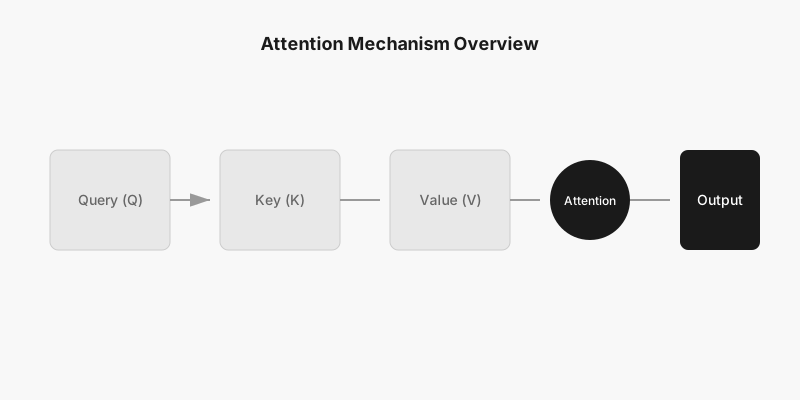
The scaling factor $\sqrt{d_k}$ prevents the dot products from growing too large, which would push the softmax into regions with extremely small gradients.
Why Scale by $\sqrt{d_k}$?
Consider two vectors $q$ and $k$ with components drawn from $\mathcal{N}(0, 1)$. Their dot product has:
Without scaling, the variance grows with dimension, causing softmax saturation.
Multi-Head Attention
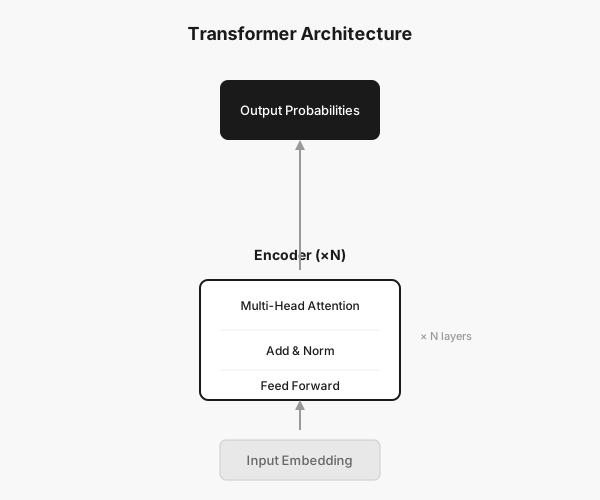
Rather than performing a single attention function, transformers use multi-head attention2:
where each head is computed as:
Multi-head attention allows the model to jointly attend to information from different representation subspaces at different positions.
Vaswani et al., “Attention Is All You Need”
Multi-Head Attention Parameters
| Model | Heads | d_model | d_k | Parameters |
|---|---|---|---|---|
| BERT-Base | 12 | 768 | 64 | 110M |
| BERT-Large | 16 | 1024 | 64 | 340M |
| GPT-2 | 12 | 768 | 64 | 117M |
| GPT-3 | 96 | 12288 | 128 | 175B |
| LLaMA-7B | 32 | 4096 | 128 | 7B |
| LLaMA-70B | 64 | 8192 | 128 | 70B |
Positional Encodings
Since transformers have no recurrence, we need to inject positional information. The original paper uses sinusoidal encodings:
This encoding has useful properties:
- Bounded values: Always in $[-1, 1]$
- Unique positions: Each position gets a distinct encoding
- Relative positions: $PE_{pos+k}$ can be represented as a linear function of $PE_{pos}$
Implementation in PyTorch
Here’s a clean implementation of scaled dot-product attention:
import torch
import torch.nn as nn
import torch.nn.functional as F
import math

class ScaledDotProductAttention(nn.Module):
    """Scaled Dot-Product Attention mechanism."""

    def __init__(self, temperature: float, dropout: float = 0.1):
        super().__init__()
        self.temperature = temperature
        self.dropout = nn.Dropout(dropout)

    def forward(
        self,
        q: torch.Tensor,
        k: torch.Tensor,
        v: torch.Tensor,
        mask: torch.Tensor = None
    ) -> tuple[torch.Tensor, torch.Tensor]:
        # Compute attention scores
        attn = torch.matmul(q, k.transpose(-2, -1)) / self.temperature

        # Apply mask (for causal attention or padding)
        if mask is not None:
            attn = attn.masked_fill(mask == 0, float('-inf'))

        # Softmax and dropout
        attn = F.softmax(attn, dim=-1)
        attn = self.dropout(attn)

        # Weighted sum of values
        output = torch.matmul(attn, v)

        return output, attn
And here’s a complete multi-head attention implementation:
class MultiHeadAttention(nn.Module):
    """Multi-Head Attention module."""

    def __init__(
        self,
        d_model: int,
        n_heads: int,
        dropout: float = 0.1
    ):
        super().__init__()
        assert d_model % n_heads == 0, "d_model must be divisible by n_heads"

        self.d_model = d_model
        self.n_heads = n_heads
        self.d_k = d_model // n_heads

        # Linear projections
        self.w_q = nn.Linear(d_model, d_model)
        self.w_k = nn.Linear(d_model, d_model)
        self.w_v = nn.Linear(d_model, d_model)
        self.w_o = nn.Linear(d_model, d_model)

        self.attention = ScaledDotProductAttention(
            temperature=math.sqrt(self.d_k),
            dropout=dropout
        )

    def forward(
        self,
        q: torch.Tensor,
        k: torch.Tensor,
        v: torch.Tensor,
        mask: torch.Tensor = None
    ) -> torch.Tensor:
        batch_size = q.size(0)

        # Project and reshape: (batch, seq, d_model) -> (batch, n_heads, seq, d_k)
        q = self.w_q(q).view(batch_size, -1, self.n_heads, self.d_k).transpose(1, 2)
        k = self.w_k(k).view(batch_size, -1, self.n_heads, self.d_k).transpose(1, 2)
        v = self.w_v(v).view(batch_size, -1, self.n_heads, self.d_k).transpose(1, 2)

        # Apply attention
        output, attn_weights = self.attention(q, k, v, mask)

        # Concatenate heads and project
        output = output.transpose(1, 2).contiguous().view(batch_size, -1, self.d_model)
        output = self.w_o(output)

        return output
Complexity Analysis
The computational complexity of self-attention is:
| Operation | Time Complexity | Space Complexity |
|---|---|---|
| $QK^T$ computation | $O(n^2 \cdot d)$ | $O(n^2)$ |
| Softmax | $O(n^2)$ | $O(n^2)$ |
| Attention × V | $O(n^2 \cdot d)$ | $O(n \cdot d)$ |
This quadratic complexity in sequence length $n$ motivates research into efficient attention mechanisms3 like:
- Linear attention4 (Katharopoulos et al., 2020)
- Sparse attention (Child et al., 2019)
- FlashAttention5 (Dao et al., 2022)
Key Takeaways
- Attention is a weighted aggregation based on query-key similarity
- Scaling prevents gradient issues in high dimensions
- Multi-head attention enables diverse feature learning
- Positional encodings inject sequence order information
- Quadratic complexity remains a key challenge for long sequences
Understanding these mathematical foundations is crucial for optimizing transformers in production systems. In future posts, we’ll explore how FlashAttention achieves IO-aware tiling to dramatically improve performance.
-
Vaswani, A., et al. “Attention Is All You Need.” NeurIPS 2017. ↩
-
Multi-head attention was a key innovation enabling parallel processing of different relationship types. ↩
-
The quadratic complexity becomes prohibitive for sequences longer than a few thousand tokens. ↩
-
Katharopoulos, A., et al. “Transformers are RNNs: Fast Autoregressive Transformers with Linear Attention.” ICML 2020. ↩
-
Dao, T., et al. “FlashAttention: Fast and Memory-Efficient Exact Attention with IO-Awareness.” NeurIPS 2022. ↩