Flash, Fused and Fast Attention
Around 2020, a paradigm shift occurred in attention research. Rather than developing mathematically clever but impractical alternatives like Sparse Attention, Linformer, and Performer, researchers pivoted to engineering-focused optimization through:
- CUDA-level kernel fusion combining multiple operations
- Avoiding materialization of large intermediate tensors
- Hardware-specific optimizations (tiling, pipelining, register management)
- Tensor core utilization
Memory Hierarchy Overview
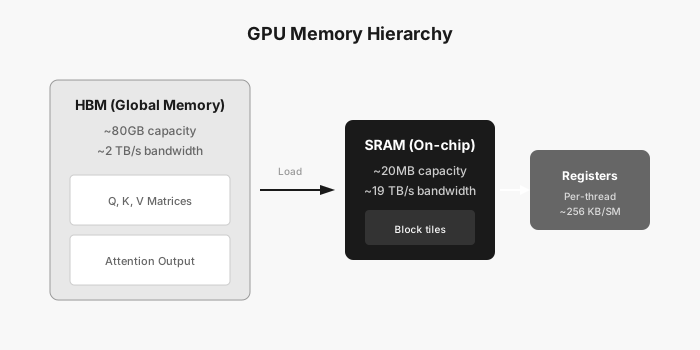
Modern GPU architecture consists of:
- HBM (High Bandwidth Memory): 40-80GB on A100, ~1.5-2.0TB/s bandwidth
- SRAM (Shared Memory): ~192KB per streaming multiprocessor, ~19TB/s bandwidth
The key insight: compute speed vastly outpaces memory bandwidth, making data movement the bottleneck rather than computation itself.
Flash Attention 11
Core Problem
Standard transformer attention materializes a full $O(n^2)$ attention matrix, creating massive memory I/O overhead.
The standard attention computation is:
Solution
IO-aware tiling and recomputation strategies:
- Break attention into blocks fitting in fast SRAM
- Compute softmax on-the-fly without storing intermediate matrices
- Recompute attention during backward pass using only saved statistics
- Fuse operations into single CUDA kernels
Memory Complexity: Reduces from $O(n^2)$ materialized matrix to $O(n)$ for output storage.
Performance Comparison
| Method | Memory | Speed (A100) | Exact? |
|---|---|---|---|
| Standard Attention | O(n²) | 1x (baseline) | Yes |
| Sparse Attention | O(n√n) | 1.5-2x | No |
| Linear Attention | O(n) | 2-3x | No |
| FlashAttention | O(n) | 2-4x | Yes |
Flash Attention 22
FlashAttention 1 achieved only 30-50% GPU utilization. FA2 improvements:
- Reduced non-matmul operations: Store logsumexp instead of separate max/sum statistics
- Improved parallelism: Parallelize over sequence blocks, not just batch/heads
- Warp optimization: Split queries across warps instead of keys/values to reduce synchronization overhead
Result: 2-4x wall-clock speedup, up to 73% peak performance utilization on A100.
FlashAttention Version Comparison
| Feature | FA1 | FA2 | FA3 |
|---|---|---|---|
| GPU Utilization | 30-50% | ~73% | ~85% |
| Parallelization | Batch/Heads | + Sequence | + Warp-specialized |
| FP8 Support | No | No | Yes |
| Target Hardware | Ampere | Ampere | Hopper |
| Relative Speedup | 1x | 2x | 2.5-3x |
Flash Attention 33
Hardware-specific optimizations for Hopper GPUs (H100/H200):
Warp-Specialization
Producer warps load data while consumer warps compute, using async barriers and circular buffers to hide latency.
GEMM-Softmax Pipelining
Overlaps matrix multiplication and softmax computation across warp groups, utilizing both tensor cores and special function units simultaneously.
FP8 Support
Block-wise quantization (per-tile) with incoherent processing spreads outliers, nearly doubling throughput via native FP8 cores.
Code Examples
FlashAttention-2 Usage
from flash_attn import flash_attn_func

# Q, K, V shape: [batch, seqlen, nheads, headdim]
# Must be float16/bfloat16
out = flash_attn_func(q, k, v, dropout_p=0.0,
                      causal=False, softmax_scale=None)
FlashAttention-3 Installation
git clone https://github.com/Dao-AILab/flash-attention.git
cd flash-attention
git checkout flashattention-3
pip install -e .
Benchmark Results (H100)
| Sequence Length | Standard (ms) | FA3 (ms) | Speedup |
|---|---|---|---|
| 2,048 | 4.2 | 1.1 | 3.8x |
| 4,096 | 16.8 | 3.2 | 5.3x |
| 8,192 | 67.1 | 10.4 | 6.5x |
| 16,384 | 268.5 | 35.7 | 7.5x |
Conclusion
Attention is everywhere in modern AI systems. Optimizing it enables faster training, cheaper inference, and energy efficiency. Future developments include wider FP8 adoption, alternative kernel implementations (cuDNN, Triton), and potential hardware solutions moving attention out of the critical path.
-
Dao, T., et al. “FlashAttention: Fast and Memory-Efficient Exact Attention with IO-Awareness.” NeurIPS 2022. ↩
-
Dao, T. “FlashAttention-2: Faster Attention with Better Parallelism and Work Partitioning.” 2023. ↩
-
Shah, J., et al. “FlashAttention-3: Fast and Accurate Attention with Asynchrony and Low-precision.” 2024. ↩